Bedding • Pillow guide
Choosing an Organic Pillow for Your Sleep Style
The pillow that feels wonderfully soft in a shop may not be the one that feels right at 2 a.m. Finding a comfortable organic pillow starts with the way you sleep, then comes down to the details: loft, firmness, fill, and how much adjustment you want to do once it’s on your bed.
Pillows are personal. One sleeper wants a lofty, steady cushion; another prefers a low, yielding layer that almost disappears beneath the head. And even people who share a mattress may have different sleep positions, body shapes, comfort preferences, or reactions to warmth. There is no universal “best” organic pillow—only the one that feels supportive and comfortable for you.
Organic and natural pillows can differ considerably in their construction. Some use latex, wool, cotton, or other fibers; some offer a fixed shape, while others have fill that can be moved or removed. Looking beyond a label and comparing the pillow’s practical features can make the choice much easier. Here’s what to know about sleep position, pillow loft, materials, care, and the small adjustments that can make a real difference.
Start with your usual sleep position
Sleep position is a useful first clue because it affects how much space needs to be filled between your head and the mattress. Think about how you spend most of the night, not just the position you happen to fall asleep in. Many people change positions while sleeping, so a pillow that works reasonably well in more than one posture may be a practical choice.
Side sleepers often need more loft
When you lie on your side, the distance between your head and the mattress is influenced by the width of your shoulders and how deeply your shoulder settles into the bed. A pillow with more loft may help fill that space, keeping the head from dipping down toward the mattress. The goal is not to push the head upward, but to find a height that feels comfortable and keeps the neck from bending sharply to either side.
Shoulder width, mattress firmness, and personal comfort all matter. A broad-shouldered sleeper on a firm mattress might prefer a different height from someone with narrower shoulders on a softer surface. That’s why broad advice such as “side sleepers need a high pillow” is best treated as a starting point rather than a rule.
Back sleepers may prefer medium height
Back sleepers often find a medium-loft pillow comfortable, though the right height depends on the individual and the pillow’s shape. A pillow that is too lofty can feel as if it tips the chin toward the chest. One that is too low may leave the head feeling unsupported. Look for a height that feels natural rather than forcing your neck into a pronounced curve.
Some pillows are shaped to cradle the head or provide a more defined area for the neck. These contours can feel reassuring to some people and unfamiliar to others. If you are considering a shaped pillow, give yourself time to assess how it feels in your usual sleeping position. A distinctive design is only useful if it suits your body and comfort preferences.
Stomach sleepers generally benefit from a lower profile
Stomach sleeping usually places the head turned to one side, so a thick pillow can feel as though it lifts the head too far from the mattress. Many stomach sleepers prefer a lower-profile pillow, or a softer option that compresses more easily. Comfort is individual, but a low loft may help avoid the sensation of being propped up.
If you change positions frequently, an adjustable pillow may be worth considering. Being able to remove or redistribute fill can help you find a middle ground, though the process takes a little trial and error. The best setting is the one that feels comfortable when you settle into your normal sleep posture.
Understand pillow loft, firmness, and support
Loft refers to a pillow’s height, while firmness describes how much resistance it offers when you rest your head on it. The two are related but not interchangeable. A pillow may look tall yet compress significantly, or have a relatively modest profile while feeling dense and supportive.
Support is the overall experience: how well the pillow maintains a comfortable position as you settle into it. It depends on the fill, construction, loft, firmness, and how the pillow responds to pressure. A soft pillow is not automatically unsupportive, and a firm pillow is not automatically a better match. The aim is a comfortable balance that does not leave you constantly folding, punching, or repositioning the pillow.
Pay attention to how a pillow behaves after your head has rested on it for a few minutes. Does it flatten quickly? Does it spring back? Can you shift the fill to suit your position? These observations may tell you more than a single firmness label, which can be interpreted differently by different manufacturers.
Compare natural and organic fill options
“Organic” describes aspects of how particular materials are grown or processed, but it does not tell you everything about a pillow’s feel. Two pillows with natural or organic components can have very different loft, resilience, and care needs. Read the full product description, including the fill, cover, construction, and any available certification details, rather than relying on a broad label alone.
Latex: resilient and adaptable
Latex pillows are often chosen for their springy, responsive feel. A molded latex pillow has a more defined shape, while shredded latex contains smaller pieces that can shift and be rearranged. That difference is important: a molded pillow tends to maintain its form, whereas shredded fill can offer more flexibility in shaping the surface.
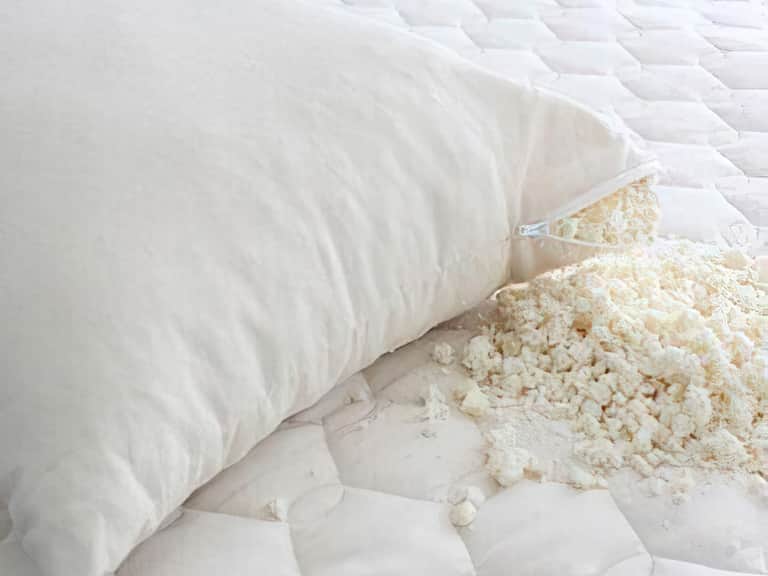
For example, the Savvy Rest Shredded Latex Pillow uses a blend of shredded Dunlop and Talalay latex and has an organic cotton outer casing. Its fill can be removed to adjust the pillow’s height and density. The listed approximate height range is four to eight inches, and the pillow is described as medium in firmness. Those details may appeal to someone who wants to fine-tune loft, though adjustable fill does require a little hands-on effort.
With shredded fill, make changes gradually. Remove a small amount, try the pillow for a few nights, and reassess before taking out more. Keep the extra fill in a clean, secure place in case you want to restore some height later. The adjustment process can be a little messy, so it is sensible to follow the product’s instructions and choose a suitable space before opening the inner casing.
Wool and cotton: consider the full construction
Wool and cotton appear in many natural bedding products, but a pillow’s feel depends on how the materials are used and combined. A cover, inner casing, fill, and quilting can all affect softness, breathability, and shape. Check whether the pillow’s fill is adjustable, whether the cover can be removed, and what the care instructions allow. A material name alone cannot predict exactly how a pillow will feel beneath your head.
Choose a material for feel as well as label
The word “natural” may be appealing, especially if you are trying to make more considered choices for your bedroom. Still, preferences differ: some sleepers like a buoyant, responsive surface; others want a softer, more compressible feel. Consider what you already enjoy in a pillow, then compare materials and construction with that experience in mind. If you are sensitive to a material or its scent, check the product information and any care or airing guidance before use.
Check the cover, dimensions, and care instructions
A pillow is more than its fill. The outer cover sits closest to your face, and its texture, breathability, and removability can influence everyday comfort. Some pillows have a removable, washable outer casing; others require spot cleaning or more careful maintenance. Confirm which parts can be washed before you buy, and follow the instructions rather than assuming the whole pillow is machine washable.
Sizing matters, too. Standard, queen, and king pillows vary in length, so check the listed dimensions against your pillowcases and bed setup. A larger pillow may give you more room to shift during the night, while a smaller size may suit a compact bed or a sleeper who prefers less material around the head. The pillow should fit its case without being squeezed into a shape that changes its loft.
- Check the fill and cover materials separately.
- Look for care instructions for both the cover and the inner pillow.
- Confirm the pillow dimensions before choosing a pillowcase.
- Find out whether the pillow is adjustable, reshapeable, or fixed in form.
- Review any relevant certifications and what they specifically cover.
Think about your mattress and bedding, too
A pillow does not work in isolation. Your mattress affects how much your shoulder sinks when you lie on your side, and that can change the space the pillow needs to fill. A mattress that lets the shoulder settle more deeply may call for a different pillow height than a firmer surface. If you are changing your mattress and pillow at the same time, it can be harder to tell which change is responsible for a new comfort sensation.
Sheets and pillowcases can also affect the way a pillow feels. A tightly fitted case may compress an adjustable or lofty pillow, while a loose case may bunch up. A protector or additional layer can change the surface feel, so include the bedding you actually use when assessing comfort. Small details can add up to a noticeably different night.
Give yourself time to find the right setting
A new pillow can feel different from the one you have used for years, even when the new option is a good match. Allow time to settle into the shape and feel, but don’t ignore persistent discomfort. If the pillow is adjustable, make modest changes and give each setting a fair try. A quick series of large adjustments can make it difficult to know which height worked best.
You can also use a simple comfort check. When lying in your usual position, notice whether your head feels level and relaxed, whether you are repeatedly folding the pillow, and whether you wake wanting to move it. These are practical observations, not a medical assessment. If pain or other symptoms persist, a qualified health professional can offer advice appropriate to your situation.
A quick guide to choosing
| Your usual position | A useful starting point | What to notice |
|---|---|---|
| Side | Medium to higher loft | Whether the pillow fills the space comfortably without pushing your head upward |
| Back | Medium loft | Whether your head feels supported without an exaggerated tilt |
| Stomach | Low loft or a compressible feel | Whether the pillow feels unobtrusive rather than lifting your head too high |
| Combination | Adjustable or adaptable construction | Whether it remains comfortable as you change positions |
These are starting points, not guarantees. A pillow that suits one side sleeper may feel entirely wrong to another. Shoulder width, mattress feel, body proportions, and personal preference all play a part. When possible, consider return or trial terms before purchasing, especially if you are trying a new pillow shape or fill for the first time.
The bottom line: match the pillow to your real routine
Choosing an organic pillow is less about chasing a perfect-sounding label and more about finding a combination of materials and design that works with your sleep habits. Start with your usual position, consider the loft and firmness that feel comfortable, and compare the construction and care instructions. If you move between positions or want room to experiment, an adjustable pillow may offer useful flexibility.
The best choice is the one you can live with night after night: comfortable, practical to care for, and suited to the way you actually sleep. Take your time, make adjustments thoughtfully, and remember that the right pillow should support your comfort without demanding all your attention.